Barcelona is one of the most vibrant and creative cities in Europe, and its urban art is one of its greatest treasures. Its streets, façades and corners hide colourful, history-filled murals full of meaning, turning every stroll into a unique experience. At the heart of it all is the Musik Boutique Hotel, a modern retreat located in El Born, just steps away from some of the most iconic street art spots in Barcelona, such as the Gothic Quarter and El Raval. With a contemporary design that breathes the same creative essence as the city, the hotel becomes the perfect base for exploring Barcelona’s urban art in all its breadth. Keep reading the Musik Boutique Hotel Barcelona Guide and discover everything that Barcelona street art has to offer!
The History of Urban Art in Barcelona
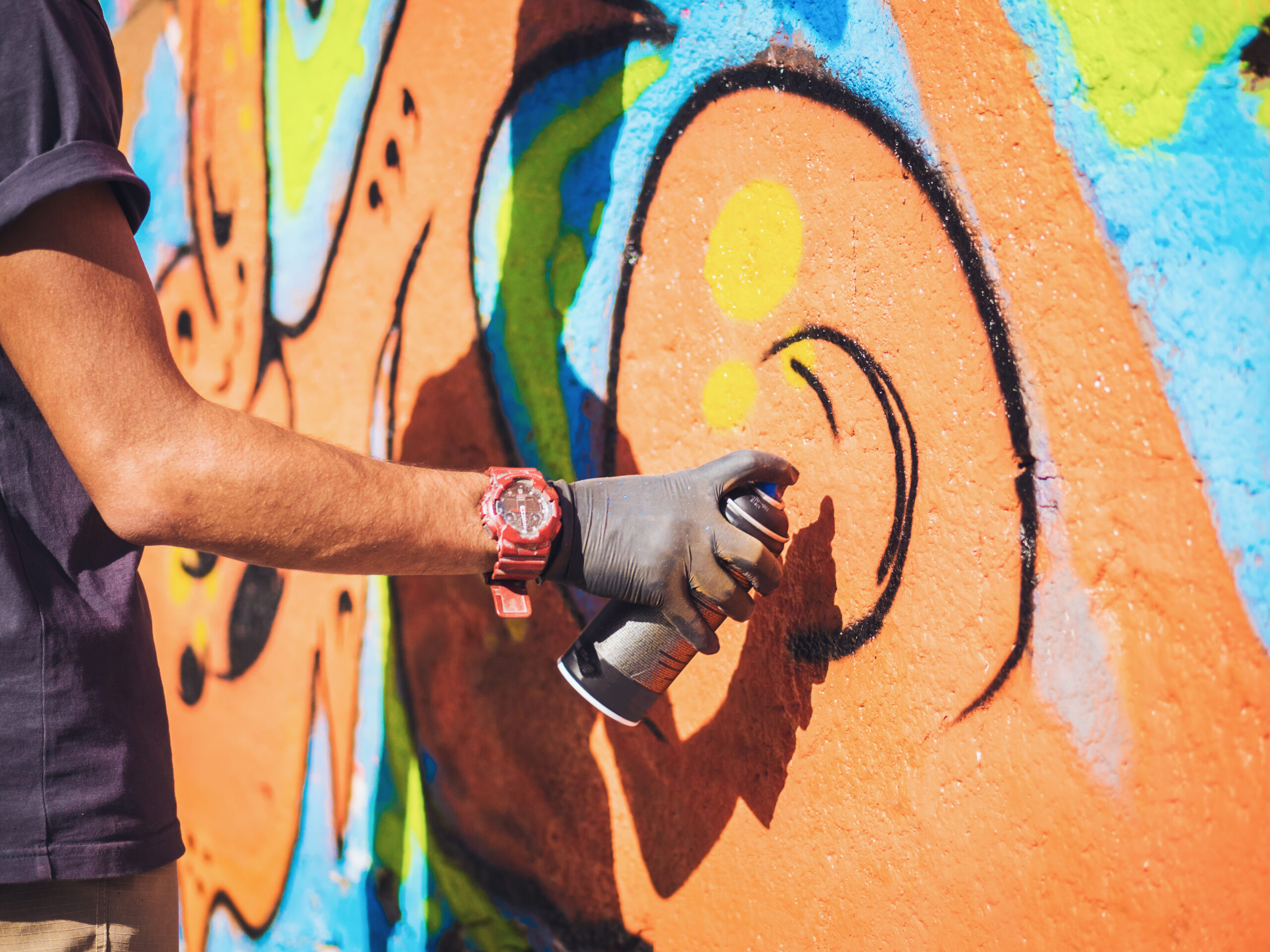
Urban art in Barcelona emerged in the 1970s and 80s as a form of protest and artistic expression. With the arrival of democracy and events such as the 1992 Olympics, the city established itself as one of the capitals of European street art, transforming industrial spaces into open-air canvases. Iconic artists such as El Xupet Negre and Pepe Otal drove this scene forward, which continues to evolve through a blend of local and international influences, positioning Barcelona as a global reference point for urban art. Exploring its murals and graffiti is a perfect activity at any time of year — even on rainy days, when wandering its art-covered streets becomes an equally special experience. If you’re looking for more ideas for those days, don’t miss our guide on what to do in Barcelona when it rains.
Where to Find the Best Graffiti and Murals in Barcelona
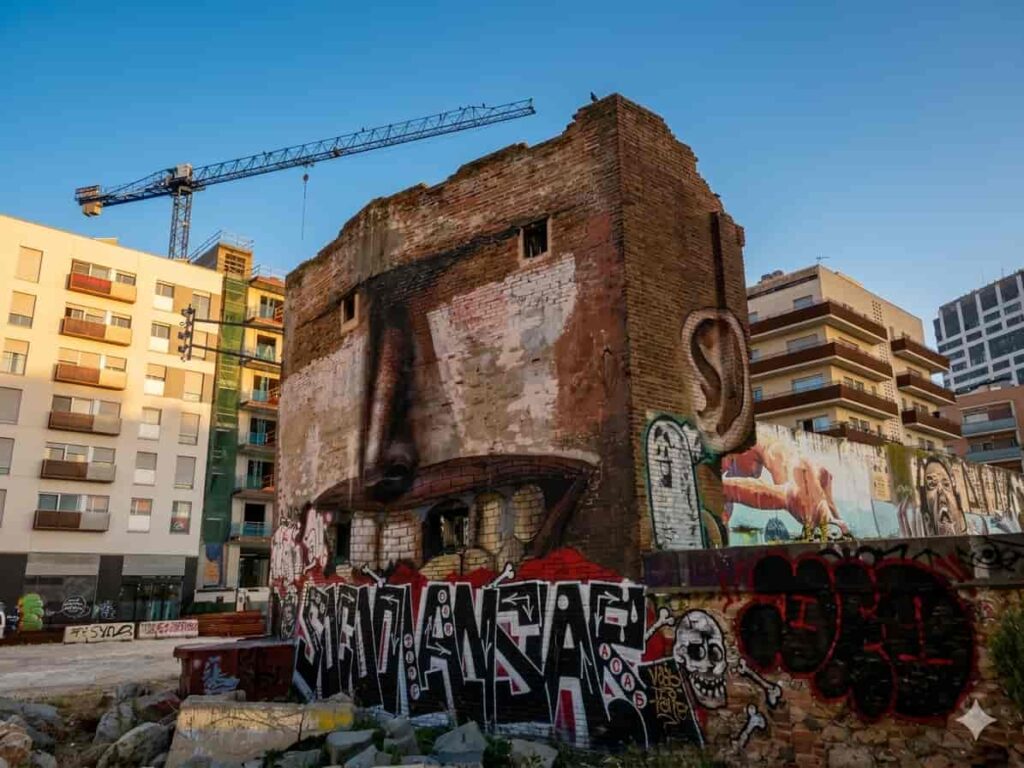
Barcelona is truly an open-air museum where works by local and international artists coexist. If you’re looking for the best street art in Barcelona, here is a list of the most famous graffiti and murals in Barcelona that you simply can’t miss:
La Escocesa (Poblenou)
La Escocesa is an old industrial factory transformed into an artistic creation centre located in Poblenou. It features exterior walls covered in enormous graffiti and murals that combine industrial history with contemporary and experimental touches. Many artists have left their mark here, such as Zosen Bandido and Ruben Sánchez. La Escocesa is a landmark of urban art in Barcelona and a space where many artists have found inspiration.
El Beso (Gothic Quarter)
Known as the Mural del Beso, this is a work created by Joan Fontcuberta in 2014 to commemorate the Tercentenary of the War of the Spanish Succession. The mural is made up of 4,000 ceramic mosaics featuring images contributed by citizens, forming a monumental kiss that reflects freedom and coexistence. It is located in Plaça d’Isidre Nonell and stands out for its great beauty and the message it conveys.
Teatre Arnau (Ciutat Vella)
The Teatre Arnau was built in the early 20th century and is now a symbol of Barcelona’s culture. It is currently undergoing restoration, but its walls have nonetheless become a canvas for urban artists. This collection of works pays tribute to the history of the theatre and its most important figures. The Teatre Arnau is a landmark of urban art in Barcelona and part of the city’s cultural heritage.
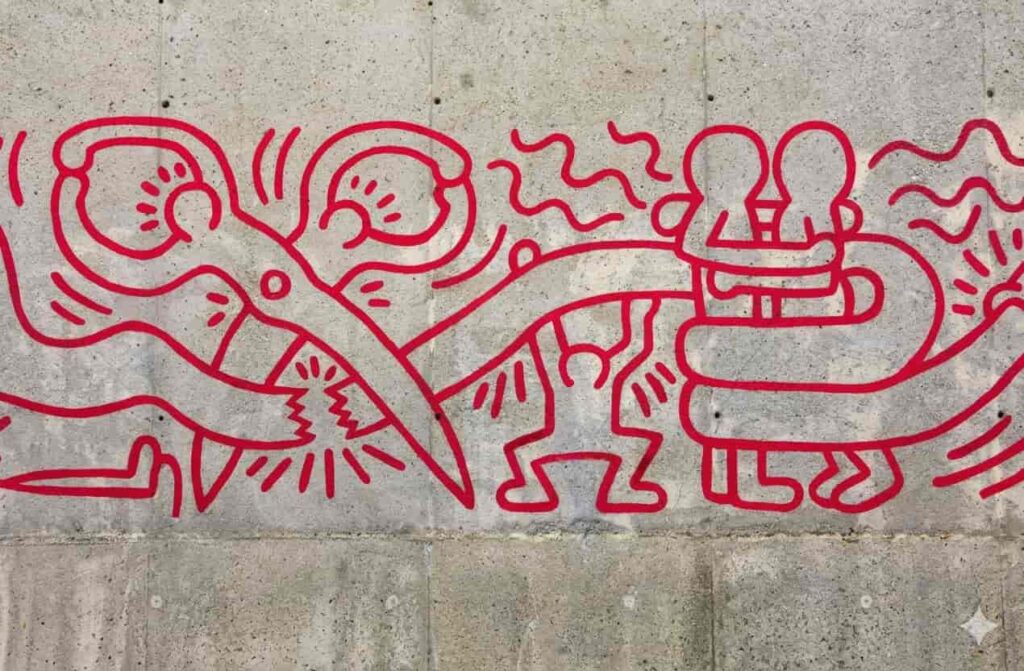
Keith Haring Mural (Raval)
This mural is a replica of the original painted in 1989 by Keith Haring, which symbolised the fight against AIDS. The original work was created in just 5 hours, using only red lines to depict intertwined bodies. In 2014, the replica was created near the MACBA as a reminder of the artist’s legacy and the importance of the message it carries.
Gats (Raval)
This mural, called Gats (cats in Catalan), is located in the heart of El Raval and was created by C215, a widely recognised urban artist. He used the stencil technique to capture the detailed expressions of street cats, which represent independence and urban life.
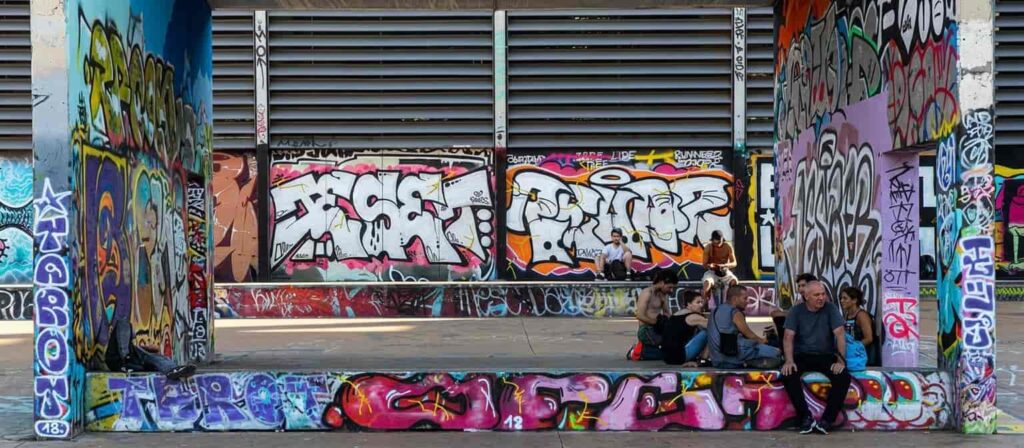
Graffiti at Las Tres Chimeneas (Poble-sec)
Las Tres Chimeneas is one of the few places in Barcelona where graffiti is legal. Located in Poble-sec, it is a meeting point for many local and international artists, making it a unique street art space in Barcelona. The murals and graffiti are constantly changing, with works ranging from classic wildstyle to more abstract styles. The site has received contributions from artists such as Kram, La Castillo and H101. This is a perfect example of how urban art revitalises spaces — and exploring it in good company makes the experience even more special. If you’re looking for inspiration for a romantic getaway, don’t miss our guide on the best things to do as a couple in Barcelona.
El Xupet Negre (Various locations)
The El Xupet Negre character was created in the 1990s and is one of the most recognised icons of Barcelona’s urban art scene. It depicts a black dummy (pacifier) symbolising childhood, creativity and rebellion. You can find it in neighbourhoods such as Gràcia, Poblenou and El Raval. Its highly minimalist style with vivid colours has made it an international reference in logo art.
La Bartola (Raval)
This mural, located in El Raval, pays tribute to local traditions and, above all, to Catalan popular culture. La Bartola was created by artists from the Catalan street art movement and combines striking colours with realistic elements. It is also a great example of how urban art transforms forgotten spaces into points of artistic interest.
Murals of Poblenou
The neighbourhood of Poblenou is an open-air mural gallery, boasting an endless number of murals and graffiti pieces. It features a rich mix of surrealism and figuration, with artists such as Aryz, alongside vibrant, dynamic works by artists like Ruben Sánchez. The neighbourhood also hosts the Open Walls Festival, where artists and the public share in the creative process together.
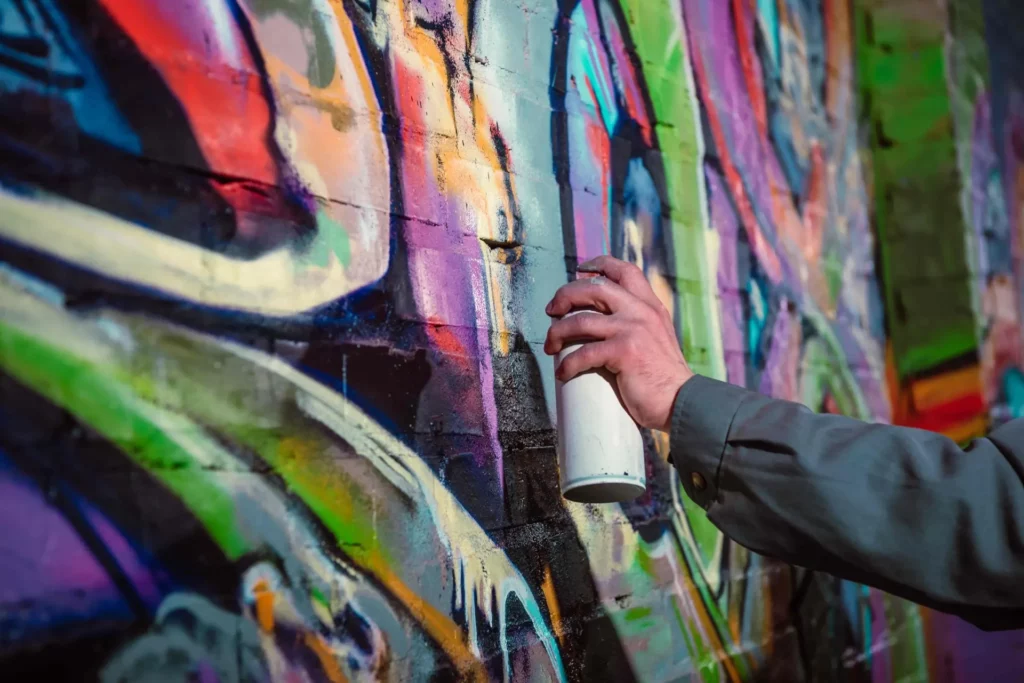
La Mujer del Muro (El Born)
This mural created by BTOY (Andrea Michaelsson) pays tribute to strong and iconic women throughout history. It also uses the stencil technique, combining a realistic style with a vintage touch to achieve a deeply nostalgic feel. These works can be found on façades and walls in El Born — the neighbourhood where the Musik Boutique Hotel is located — making them a wonderful discovery for those strolling through the area.
Àgora Juan Andrés Benítez (Raval)
The Àgora Juan Andrés Benítez is a community space that honours a local resident whose death sparked a tremendous wave of solidarity in 2013. The walls of the space are covered in murals and graffiti reflecting themes such as social justice, historical memory and community.
Museu a Cel Obert (Sant Andreu)
This is a project that transforms walls in the Sant Andreu neighbourhood into giant murals. It features abstract and geometric works bursting with colour, contributed by artists such as Zosen Bandido and Ruben Sánchez. The museum also organises activities that turn the neighbourhood into a cultural landmark of urban art in Barcelona — fully accessible and dynamic.
Carrer Pere IV (Poblenou)
Carrer Pere IV is a well-known street art destination in Poblenou, where artists such as Axel Void and Miss Van have created large-scale murals. These works reflect the contrast between the neighbourhood’s industrial past and its artistic evolution, establishing this street as a must-visit for street art lovers. Exploring it is also a perfect activity for the whole family, as the large-format murals capture the attention of younger visitors and spark their curiosity and creativity. If you’re looking for more ideas to enjoy Barcelona with children, take a look at our guide on Barcelona with kids: plans for the whole family.
Las Caras de Gràcia (Gràcia neighbourhood)
In the Gràcia neighbourhood, small artistic interventions known as Las Caras de Gràcia (The Faces of Gràcia) depict anonymous faces on walls and corners throughout the area. These works add a human and creative touch to Barcelona’s urban landscape. Created by emerging artists, they make Gràcia a perfect place to explore Barcelona’s urban art scene.
Welcome to Barcelona (Port Fòrum)
This mural by Aryz, located at Port Fòrum, subtly critiques the issue of over-tourism. It uses soft colours and a combination of realism and abstraction, depicting enigmatic figures that invite reflection. It is a visually striking work that transformed this space entirely.
Routes to Discover Urban Art in Barcelona
For those who want to explore Barcelona’s urban art scene on foot or by bike, here are some recommended routes:
Poblenou Route
This route begins at the Parc del Centre de Poblenou and continues along Carrer Pere IV. Along the way, you’ll discover giant murals and graffiti on old factories — ideal for photos and unique visual experiences.
Raval and Gothic Quarter Route
The second route starts at the Rambla del Raval, where you’ll encounter street art by local artists and alleyways filled with small but impressive pieces. The route ends at the MACBA mural, another iconic Barcelona landmark.
Poble-sec and Montjuïc Route
If you want to explore the Las Tres Chimeneas space, this is the route for you. The urban art here is constantly changing, and the route eventually takes you up towards Montjuïc, where hidden murals can be found on historic buildings.
Sant Andreu Route
The final route takes you through Sant Andreu, where you’ll visit the open-air urban art museum. From there, you’ll continue through the quieter streets of this residential neighbourhood.
These routes offer a blend of art, history and culture, making them ideal for locals and tourists alike.
Famous Murals and Graffiti in Barcelona That No Longer Exist
Street art in Barcelona is constantly changing due to its ephemeral nature. Some murals and graffiti have disappeared over time, leaving only memories and photographs behind. Here are the most well-known:
Keith Haring’s Mural in El Raval (1989)
The original Keith Haring mural symbolised the fight against AIDS. It was painted in 1989 in El Raval and, although it disappeared over time, a replica was created near the MACBA in 2014 to preserve the artist’s legacy and the message it carries.
The Kiss Mural at Plaça d’Isidre Nonell
The Kiss Mural, created in 2014 by Joan Fontcuberta, is a collage of 4,000 images forming a kiss as a symbol of freedom and coexistence. Over time it suffered vandalism and damage, and was partially removed and restored — its current state is no longer complete.
Graffiti at La Carbonería
La Carbonería was an iconic squatted space in the Eixample. For many years it served as a canvas for protest-driven urban art, with graffiti and murals covering its walls. In 2014 it was evicted and demolished, bringing this urban gallery to an end.
Murals at the Can Ricart Factory in Poblenou
The Can Ricart factory in Poblenou was a major landmark of Barcelona’s urban art scene, with walls covered in graffiti and murals. Gentrification and urban renewal erased most of the works, leaving few traces of this iconic space.
These examples reflect how fragile street art in Barcelona can be — but at the same time, they also reflect its capacity to reinvent itself and be reborn in new spaces.
How Urban Art Has Transformed Barcelona’s Neighbourhoods
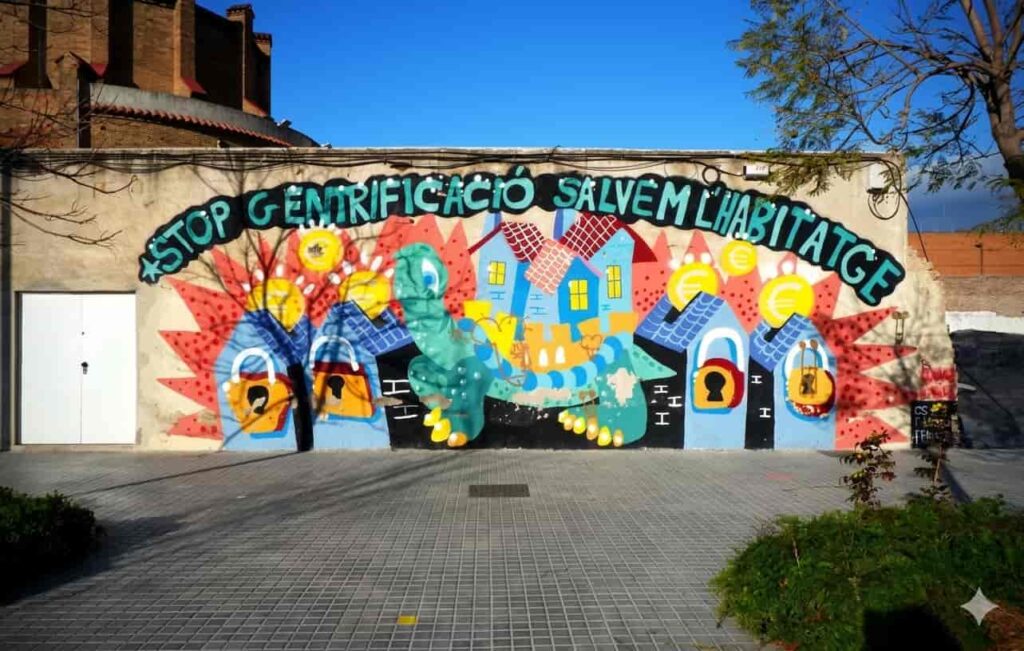
Urban art in Barcelona is not just an artistic expression — it is also a powerful tool for urban and social transformation. Neighbourhoods such as Poblenou, El Raval and Sant Andreu have undergone a genuine reinvention thanks to street art, turning former industrial areas and run-down spaces into cultural destinations. Barcelona’s murals have breathed new life into forgotten façades, attracted tourism and generated a sense of identity and pride among residents. This phenomenon has also boosted the local economy, encouraging the opening of galleries, cafés and creative spaces that coexist alongside the open-air works. However, this transformation is not without debate: the popularisation of urban art has brought with it processes of gentrification that have changed the social fabric of some neighbourhoods. Despite this, Barcelona’s urban art continues to serve as a bridge between history and the present, between protest and beauty, proving that art on the street is, above all, a living reflection of the city and its people — a city that, beyond street art, hides an equally fascinating architectural heritage still waiting to be discovered, such as what you’ll find on our lesser-known Modernista routes in Barcelona.
Discover Barcelona’s Urban Art from the Musik Boutique Hotel
If you want to experience Barcelona in a different and authentic way, the Musik Boutique Hotel is the perfect starting point for exploring Barcelona’s street art. Located in El Born, one of the city’s most creative and charming neighbourhoods, the hotel places you just steps away from some of Barcelona’s most iconic murals and urban art routes you simply can’t miss. Its contemporary design and artistic atmosphere connect perfectly with the essence of Barcelona’s urban art, ensuring the cultural experience begins the moment you walk through the door.
What’s more, through the Musik Boutique Hotel Barcelona Guide you’ll find all the tips, routes and recommendations you need to discover the best urban art the city has to offer, with everything you need to make the most of your visit. Whether you’re a passionate street art enthusiast or simply want to discover the city through its streets and neighbourhoods, the Musik Boutique Hotel offers everything you need to make your stay unforgettable. Book your stay and let yourself be surprised by the art that breathes from every corner of Barcelona.